
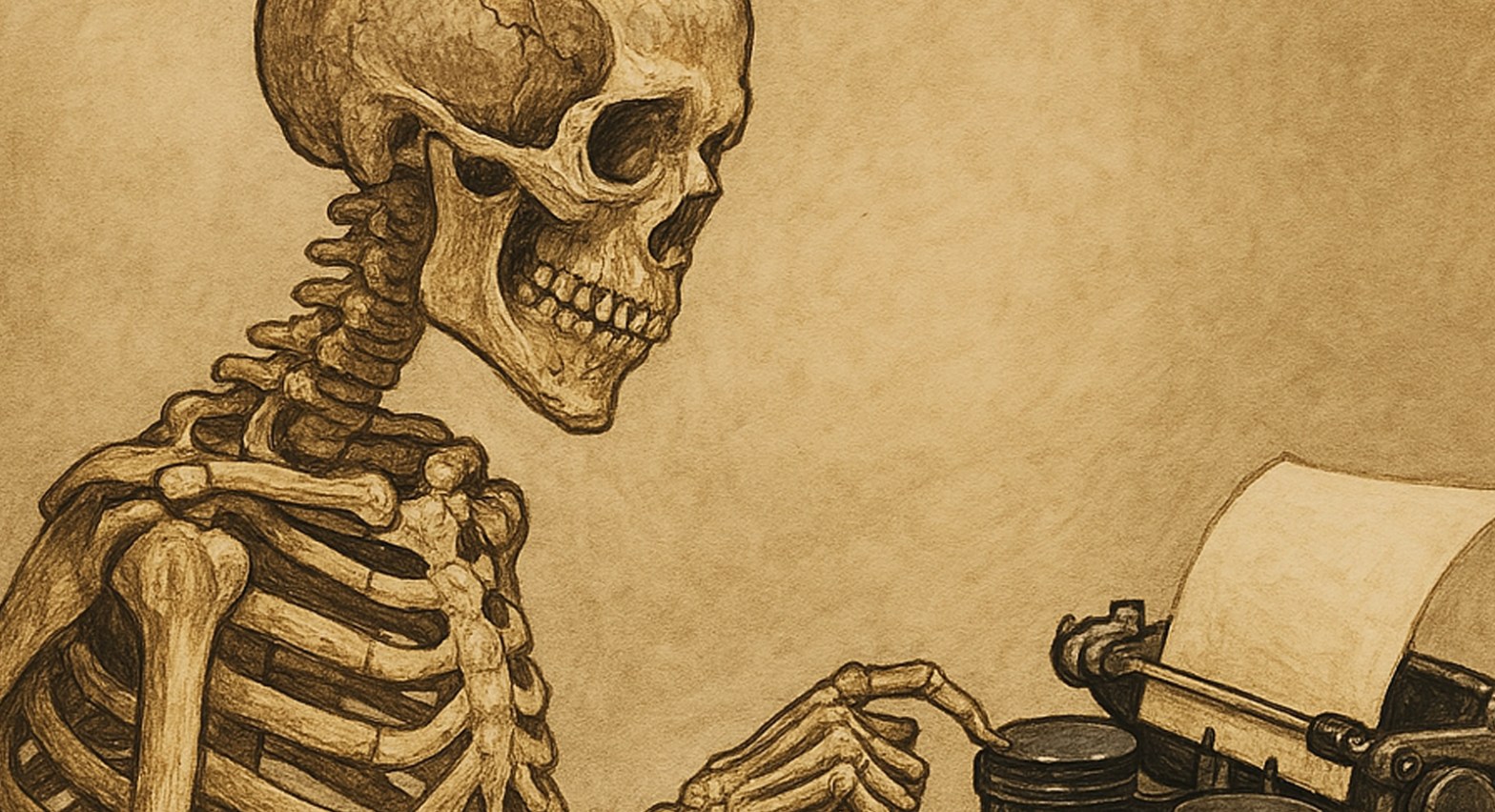
The vast majority of my time is given over to the service of others – a life I have chosen and I’m very happy about. I live and work as an English teacher and pastoral carer in a boarding school, for a modest salary, so I continue to work as a freelance writer and media man to compensate. (Although I do love these roles too, so it’s not quite as arduous as it sounds!)
Plus, I write for pleasure. The ‘downside’ is that I don’t have time to do this when the school term is in full swing, so I’ve gotten into the habit of buckling down and churning out my own ‘passion projects’ in the school holidays. And the more I’ve done this, the quicker I’ve become. Last August, I broke a new personal record by churning out a 20,000 word novella in four days.
Then, in 2025, I was asked to give a lecture to GCSE students about descriptive writing. There is a question on their exam papers which requires them to write a short story in about 45 minutes, using either an image or an opening / closing line as a stimulus. So the aim of the lecture was to offer advice on how to deliver an effective piece of prose within a short time-frame.
As part of my research for this lecture, I stumbled across a fun fact. According to Google, the fastest book ever written is John Boyne’s The Boy in the Striped Pyjamas, which was churned out in just two and a half days. Which blew my mind.
And this titbit lingered, like an itch, and as my own typing grew faster and faster, I found myself thinking: could I produce a novel in just two and a half days? Or could I even beat Boyne’s record?
Therefore, during the Easter holidays of 2025, I attempted the challenge. You can watch the video of my experience below…
And as you’ve probably gleaned from the title of this article, I didn’t quite manage to topple the great Boyne from his throne, but I came close: three and a half days. Although, in fairness to me, I did also manage to squeeze in five miles of walking each day, and I slept for approximately five / six hours per night.
Boyne, on the other hand, went without sleep – which is gutsy. This is what he said in an article in the Irish Times: “When I wrote The Boy in the Striped Pyjamas, the idea came to me on a Tuesday evening, I began writing on Wednesday morning and continued for 60 hours with only short breaks, not sleeping on Wednesday or Thursday nights and finishing the first draft by Friday lunchtime.”
Yowza. My approach was different. I spent about 90 minutes bashing out a chapter plan on Monday morning, and then began in earnest on Tuesday morning at 7:37am. I then wrote without stopping (bar meals and walks) until around 8-10pm each night, and then got back to my desk for 7:30am the following day. And I repeated this pattern until 10:47pm on Friday evening, when I hit the exact length of The Boy in the Striped Pyjamas: 46,778 words. (And yes, I stuck to Boyne’s word count, which was a challenge in itself!)
Would I recommend anyone go through this experience? Well, let me start with the positives. First, the laser-like focus that comes with doing nothing other than writing a particular piece, hour after hour, day after day, certainly serves the material. As a writer, I don’t think I’ve ever been sharper; I was so utterly immersed in the world of my characters, and firmly strapped into their shoes, from dusk ’til dawn.
Second, there is a certain ‘thrill’ about being up against a ridiculous deadline. I always think back to a line from Tim Minchin’s BAFTA song: “No one’s stronger than an artist in a crisis.” I did get a kick out of the sheer ‘ballsyness’ of such a Herculean endeavour. Plus, when I’d finished, I felt euphoric, even if (as you can see in the video) my particular brand of celebration was limited to coloured lights and chocolate. But the sense of achievement was second-to-none, and I’m incredibly proud of the fact that I ‘touched the peak’ of a metaphorical mountain that few writers have reached.
Were there drawbacks? Absolutely. For a start, because I work for three other companies, I had to cram a week’s worth of work into Monday so that I could leave the rest of the week clear for the novel. This was tough.
Second, I had to forego human contact (or indeed any kind of personal pleasure) and just write like my life depended on it. I literally sat in my room and typed for half the week, without speaking to anyone (virtually) and without stopping. And this wasn’t great for the soul.
Finally, writing at this speed didn’t give me any chance to review what I’d written. And even as I pen this article, I have yet to look back on my novel. This goes against my preferred method of working, which is to tweak as I go. And I gather John Boyne had the same problem, as he went on to re-draft The Boy in the Striped Pyjamas some 10 times before submitting it for publication. And I’m certain that my manuscript, as it stands today, will need work.
At the same time, I believe (hope!) I’ve got something of value. Can a writer ever be truly objective about their own material? Maybe not, but I do think any author worth their salt knows when they’ve struck gold, or at least, can recognise a blip on their metal detector. I know that this book has potential; it’s certainly not illegible garbage, and I know exactly the kind of person who will want to read it, so my next job is to find them.
After I’m done editing, that is. Oh boy, the editing.
But I do hope, if nothing else, that this article and video will inspire you to have a go for yourself, if you’re a budding writer, or indeed a published author. The John Boyne Challenge, as it shall henceforth be known, is the Everest of noveldom, and let me tell you, the views from the summit are worth seeing. So grab your ice-pick and guide-rope, and come join me.
And if you’re a publisher, call me!
 Studio Skerratt